Sleep Token Hid the Album Behind a Puzzle and Debuted at Number One
Put this on while you read
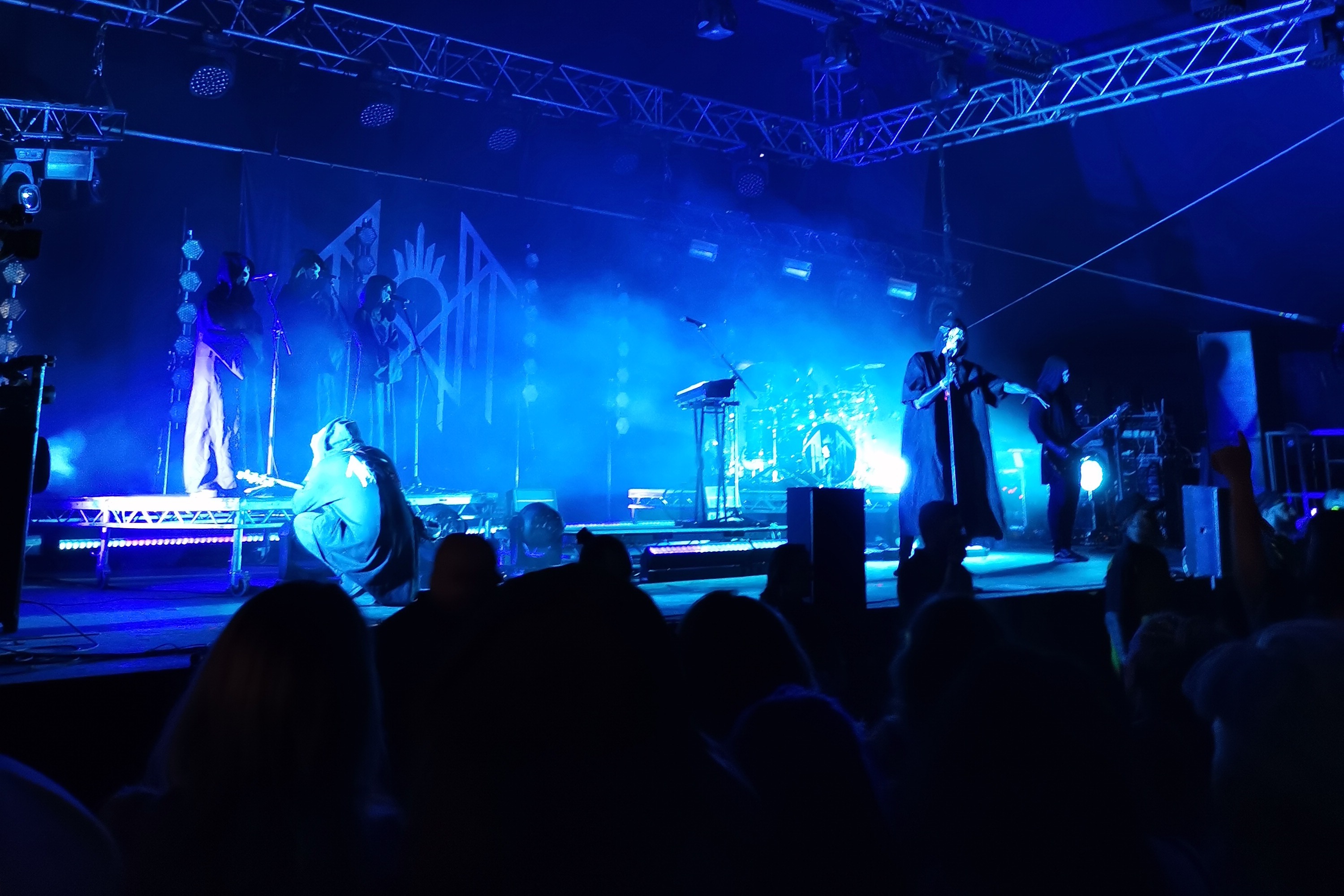
In February 2025 a website appeared with nothing attached to explain it. Visitors to showmehowtodanceforever.com found a jumble of characters and an instruction to rearrange them into the Shugborough inscription, Liner Note The Shugborough inscription reads DOUOSVAVVM, carved into the Shepherd's Monument at Shugborough Hall in Staffordshire. It has never been decoded. The monument depicts Poussin's Et in Arcadia ego, the phrase the album title plays on. Source ↗ . Getting it right exposed a set of coordinates buried in the page source.
That was the opening move of a three-month rollout for a record by a band whose members perform in masks under numbers and a stage name.
The clues refused to stay in one place. Two private Instagram accounts posted unlabeled sheet music. A YouTube premiere countdown carried a string of binary. Rival fan factions organized around two houses, House Veridian and The Feathered Host, each with its own motto. A Billboard interview ran with capital letters scattered through the body text that spelled Damocles when pulled out in sequence. A meteorologist at WRAL-TV in Raleigh worked the word Caramel into an on-air forecast. The tracklist finally arrived on Liner Note The Even in Arcadia tracklist was revealed on 18 April 2025 through two puzzles hosted on Spotify, roughly three weeks before release. Source ↗ .
Liner Note Even in Arcadia was released 9 May 2025 through RCA Records, produced by Carl Bown with Vessel. It debuted at No. 1 on the Billboard 200 with 127,000 album-equivalent units including 73,500 pure album sales. Source ↗ on May 9, 2025, moving 127,000 album-equivalent units in its first week. 73,500 of those were people buying a copy outright.
What the Puzzle Was Actually For
A press release delivers information to everyone at once. This rollout could not deliver it to anyone alone. Look at where the clues lived: a regional television weather segment in North Carolina, a print interview, the Spotify backend, two anonymous Instagram accounts, the source code of a web page. Those channels share almost no audience. No single fan was watching all of them. Solving the rollout meant a stranger in Raleigh screenshotting a forecast for a stranger in Manchester who had the binary but not the coordinates. Finishing the puzzle required a crowd. The crowd found that out by finishing it.
By release day the audience had spent three months doing unpaid work on a record they had not heard. They had built spreadsheets, Discord channels and rival factions. They had a vocabulary. Whatever the album turned out to be, they were not arriving at it cold.
Critical reception ran in the opposite direction from the sales. Pitchfork scored it 2.3 out of 10, calling it smooth, flat and edgeless. Sputnikmusic gave it 1.5 out of 5 and the phrase “almost offensively boring.” The Guardian’s Ben Beaumont-Thomas named it the worst album of 2025 and Paste placed it second worst. NME gave it five stars. The Metacritic aggregate settled at 64 from eight reviews.
That spread would ordinarily be fatal. A record splitting this hard tends to stall, because the undecided listener reads the consensus and moves on. Nobody in this audience was undecided. They had been solving for the album since February. A review landing in May arrived after three months of labor had settled the question.
◆ Before you read on
What's the PM move here?
Think about the last feature you shipped with a tooltip, a tour and a changelog entry explaining it.
You predicted:
Everything Explained on Arrival
Product teams are trained to remove friction from comprehension. Onboarding tours, empty states with instructional copy, changelog entries that open by explaining the reasoning, tooltips on anything ambiguous. Each one is defensible alone and the aggregate is a product that arrives fully narrated. The user knows what the feature does because they were told. They can also forget it at no cost, having spent nothing to get it.
Withheld information only works when something underneath rewards the search. A puzzle guarding a thin product produces resentment. Resentment travels faster than curiosity. Sleep Token could run this rollout because the record sat on a mythology built across three prior albums that paid out when fans dug into it.
Before You Explain It
Ask what the user does with the explanation. If the answer is “understands the feature,” a tooltip is correct and you should ship it. If the answer is “understands why this product exists,” the explanation is doing work the product should be doing.
Discovery that needs a second person builds something a feature cannot. Sleep Token’s clues sat in channels no individual monitored. Anything a user can only work out by talking to another user creates a tie between them your product never had to manufacture.
A puzzle guarding a shallow product tells the user their time was worth less than the reveal. The test is whether someone who does the work finds more than someone who reads the summary. If the summary is sufficient, publish the summary.
Rockstar spent three years saying almost nothing about Grand Theft Auto VI and watched the vacuum fill with frame-by-frame trailer analysis. FromSoftware ships games with no quest log and lets the wiki do the tutorial. Neither borrowed the idea from the other.
Both made the call before the product existed. After launch, the explaining has already happened.
◆ Your Take
What does your product explain on the user's behalf that they would hold onto harder if they had to work it out?
When you read this before, you wrote:
Your takeaway: